
US debt has crossed $40 trillion for the first time, and that number arrived a lot sooner than most budget forecasters had expected. The US national debt has basically doubled in under ten years, and right now, that pace is what worries economists the most. At the time of writing, Washington is still borrowing at a rate that outpaces what it collects in taxes, and that gap is feeding a national crisis that touches almost every corner of the economy. So what does US debt today actually mean for regular people, for markets, and for the choices lawmakers face next?
Source: Mortgage Rates Keep Rising: What Could Bring 30-Year Rates Down?
US Debt Hits $40 Trillion as Interest Costs Squeeze Americans

The US debt chart below shows how steep that climb really is. And it also shows something else, this isn’t a sudden spike, it’s a decade of adding more and more on top.
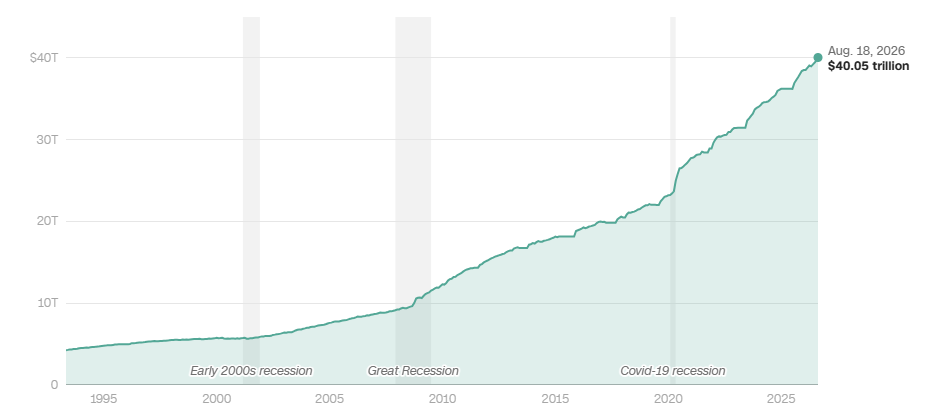
Source: US Treasury, Bureau of the Fiscal Service
Why US National Debt Keeps Climbing So Fast
Even a quick look at the chart shows the acceleration of recent years. Budget watchers are on edge right now over the pace. National debt rose by about $1 trillion in just the last five months, and the government has already racked up a $1.8 trillion deficit for the first ten months of this fiscal year, more than it ran for all of fiscal 2025. Treasury data show the government borrowed close to $14 billion a day in July. An aging population also plays a part, since Social Security and Medicare costs keep climbing as roughly 10,000 Baby Boomers retire every day, and tax cuts passed since 2017 have piled trillions more onto US national debt.
Marc Goldwein, senior policy director for the Committee for a Responsible Federal Budget, said:
“Our debt is begetting more debt. It creates a vicious cycle.”
US Debt Interest Payments Reach Record Highs
Carrying this much isn’t cheap, and interest payments are expected to top $1 trillion this year, a record. Those costs have more than tripled over five years, and they’re now close to Medicare as the government’s second biggest expense behind Social Security, more than what Washington spends on national defense. Treasury yields have been climbing too, with the 30 year note hitting its highest level since 2007, and that’s pushing US debt interest payments even higher while also feeding through to mortgages, auto loans and business borrowing across the wider economy.
Sen. Rand Paul (R-Ky.) wrote on social media:
“We just hit $40 trillion.”
What US Debt Today Means for the National Debt Crisis
At $40.05 trillion, the debt now works out to something like $117,000 per person, and about $297,000 per household. The Peter G. Peterson Foundation says that’s close to the combined economic output of China, Germany, Japan, the UK and India put together. Moody’s also stripped the US of its last top credit rating back in 2025, and Congress raised the debt ceiling by $5 trillion last year, so another fight over the borrowing limit probably won’t happen until 2027. Budget watchdogs keep saying the window to act on the national debt crisis is closing, and every month that passes adds more to US debt interest payments that future taxpayers will end up owing.
Maya MacGuineas, president of the Committee for a Responsible Federal Budget, had this to say:
“No one knows how many more of these milestones America can take.”
None of this means a crash is coming tomorrow, and it’s worth saying that clearly. US debt hits $40 trillion this week, and even people who’ve tracked this story on the US debt chart for years admit the pace is unusual. Rising yields, growing interest costs, and a national debt crisis that keeps getting bigger are already shaping mortgage rates, government budgets, and how much room lawmakers actually have left. US debt today looks set to keep climbing well past this latest record.