
Ethereum is losing momentum after breaking below the $1,900 mark — a level that had been holding as the last meaningful support before the price structure enters territory not seen since the depths of the previous cycle. The breakdown is significant — and a CryptoOnchain analysis has identified a structural divide in the on-chain data that explains the current weakness in a way that is more nuanced than straightforward selling pressure.
The divide sits between Ethereum’s illiquid and liquid supply layers — and they are moving in opposite directions simultaneously. The staking ecosystem continues expanding, with over 32.5% of total ETH supply now committed to validator infrastructure — approximately 39.5 million ETH locked in staking contracts. That record commitment reflects a cohort of long-term holders whose conviction has not wavered despite the price decline.
Against that growing illiquid base, the liquid trading layer is contracting. Exchange reserves are declining. The Coinbase Premium Index remains deeply negative relative to its 90-day average — confirming that US institutional spot demand has not returned to absorb the supply that is reaching the market. Median on-chain transfer value has fallen approximately 96% below the 90-day baseline — a near-complete withdrawal of the smaller, routine transaction activity that characterizes a healthy and engaged network.
The picture CryptoOnchain assembles is not one of panic selling. It is one of structural disengagement — and the Binance stablecoin netflow data averaging -$64 million per day confirms that the purchasing power needed to reverse that disengagement is draining rather than building.
32 Million ETH Staked and Locked
The CryptoOnchain analysis adds the derivatives dimension that prevents the current weakness from being read as a simple bearish confirmation. Binance funding rates have surged more than 3,700% above their 90-day average while open interest has increased nearly 9% — readings that would typically suggest aggressive bearish speculation building into a declining price. The short liquidation data contradicts that interpretation entirely. Short liquidations across exchanges have fallen 85% and remain near zero.

That absence is the signal. Distribution phases and aggressive bearish cycles typically feature elevated short activity as traders pile into positions betting against weakening prices. The current environment shows the opposite — funding rates elevated and open interest rising without the short liquidation activity that would confirm bearish speculation is driving the move. The weakness appears to be genuine spot selling rather than derivatives-driven pressure.
The structural conclusion the analysis reaches follows from the combined picture. Ethereum is entering a phase where its staked and illiquid supply is becoming increasingly detached from short-term market behavior. With more than one-third of the total supply removed from active circulation and the liquid market continuing to contract, the available float for trading is shrinking.
If spot selling pressure exhausts itself without triggering a derivatives liquidation cascade — which the near-zero short liquidation data suggests remains possible — the ongoing contraction in liquid supply creates the conditions historically associated with sharper and more constrained market responses to returning demand.
Ethereum Price Tests Major Support After Losing $2,000
Ethereum remains under significant pressure after decisively losing the psychological $2,000 level and breaking below the cluster of moving averages that had supported the recovery throughout April and May. The daily chart shows a clear deterioration in market structure, with ETH now trading near $1,885 after briefly dipping toward the $1,800 support zone.
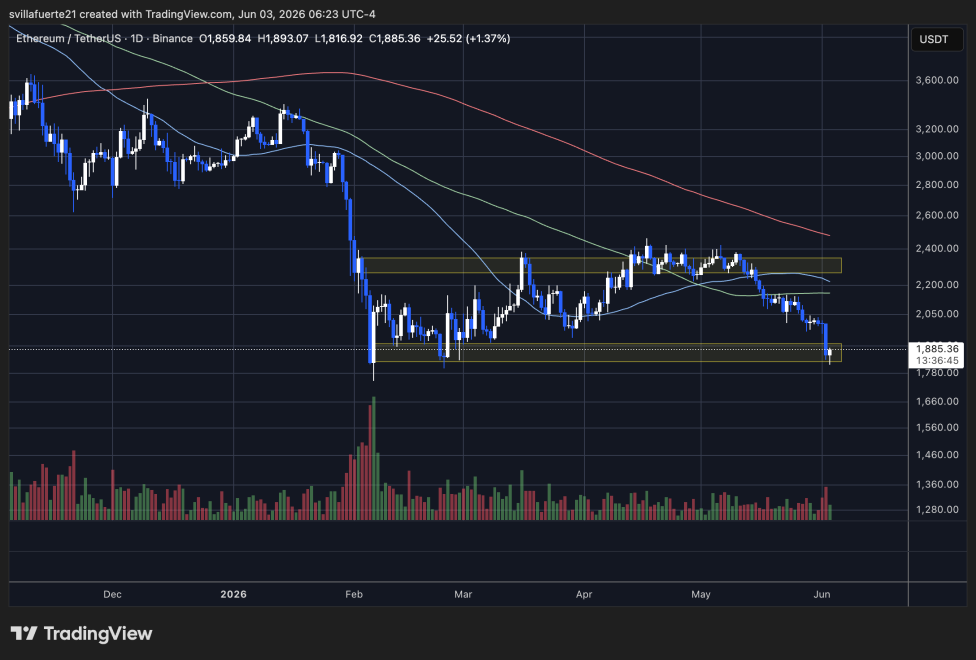
The most important development is the rejection from the $2,250-$2,350 resistance region. That area capped every recovery attempt during the past two months and ultimately triggered the current decline. Since then, ETH has fallen below both the 50-day and 100-day moving averages, while the 200-day moving average near $2,500 continues to trend lower, confirming that the broader trend remains bearish.
The $1,800-$1,850 zone is now the critical area to watch. This region acted as a major accumulation range following the February capitulation event and is currently attracting buyers again, as evidenced by the long lower wick and rebound visible on the latest candle. However, volume has not expanded significantly during the bounce, suggesting that conviction remains limited.
If bulls can defend this support and reclaim $2,000, Ethereum could attempt another move toward the $2,200 area. Failure to hold above $1,800 would invalidate the current range structure and expose the market to a deeper retracement toward levels not seen since the first quarter. For now, ETH remains locked in a decisive battle between long-term support and persistent selling pressure.
Featured image from ChatGPT, chart from TradingView.com
News Link: https://bitcoinist.com/ethereum-quietly-splitting-into-two-markets-bulls/